


AI Product Photography Cost in India: AI vs Traditional Photoshoot
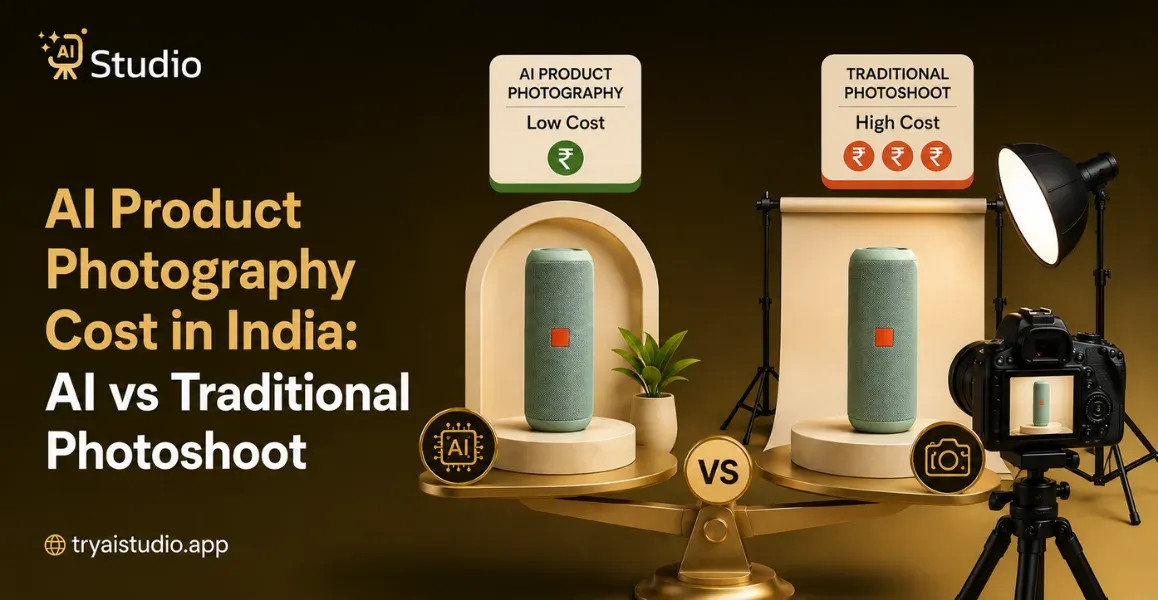
A seller with 80 SKUs ready for Amazon and Shopify usually faces the same problem around launch time. The inventory is packed, the listings are half written, and then the photography quote arrives. Suddenly a small part of the budget looks like the biggest line item on the sheet.
That is when most Indian ecommerce sellers start asking the same question: is a traditional photoshoot still worth the cost, or can AI product photography lower the expense without creating new problems? The answer depends on catalog size, product type, and how often new SKUs are added. This article explains the actual cost of product photography in India, how AI product photography pricing works, and when each option makes financial sense.
How Much Does Product Photography Cost in India?
Traditional product photography in India typically costs between roughly 300 rupees and 4,000 rupees per image, depending on the photographer, city, editing needs, and whether models are involved, according to pricing published by Indian product photography studios. AI product photography, by contrast, is usually priced through monthly subscriptions or credit packs, often starting in the low hundreds of rupees per month rather than being charged per shoot.
Here is a quick side-by-side view before going into the details.
| Cost Factor | Traditional Photoshoot | AI Product Photography |
|---|---|---|
| Photographer | Usually required | Usually not required |
| Studio | Often required | Not required for generation |
| Models | Required for model shoots | AI-generated models may be available |
| Background | Physical setup or editing | AI-generated |
| Photo editing | Often manual | AI-assisted |
| Reshoots | Extra scheduling and cost | Images can be regenerated |
| Turnaround | Usually longer | Usually faster |
| Scaling | More operational work | Easier for larger catalogs |
These are general patterns rather than fixed rules. A premium studio with an experienced retoucher will always cost more than a basic white-background shoot, and AI pricing varies just as much between tools.
Traditional Product Photography Cost in India
The final bill for a traditional shoot is built from several separate costs, and each one moves the total in a different direction.
- Photographer fees. This usually forms the base cost and can vary by experience level, the complexity of the shoot, and whether it is a per-image or per-day arrangement.
- Studio rental. Renting a proper lighting setup and space adds a fixed cost per session, even before a single product is photographed.
- Models. For fashion, jewelry, or lifestyle shoots, model fees can be one of the largest expenses, especially when multiple looks or outfit changes are needed.
- Makeup and styling. On-model shoots often need a stylist or makeup artist, which adds another line item most sellers do not budget for upfront.
- Props. Backgrounds, surfaces, and styling props for lifestyle images carry their own sourcing and rental cost.
- Lighting and equipment. Specialized lighting for reflective products like jewelry or glassware can require additional gear or a more experienced photographer.
- Editing and retouching. Color correction, background removal, and shadow work are usually billed separately from the shoot itself.
- Logistics. Shipping products to a studio, or paying a photographer to travel to a warehouse, adds both cost and time.
- Reshoots. If lighting, angles, or product presentation do not work the first time, doing it again means paying for the session twice.
For a rough sense of scale: a seller booking a standard ecommerce shoot with a professional photographer in India might see quotes anywhere from a few thousand rupees for a small batch of simple white-background images to well over 15,000 rupees for a session that includes models and styling, based on pricing ranges published by Indian photography studios. This is an example range, not a fixed quote, since actual pricing depends heavily on the studio, city, and product category.
What Makes Traditional Product Photography Expensive?
The photographer's fee is only one part of the total cost. A lot of the real expense sits in coordination: booking a studio slot, confirming model availability, transporting products safely, and scheduling everyone for the same day.
Reshoots add further cost when lighting or angles do not turn out right, and revisions during editing can stretch the timeline by days. For sellers working toward a launch date, every delay in getting final images is also a delay in going live, which has its own indirect cost.
What Is AI Product Photography?
AI product photography is the process of turning a real product photo into a polished, ecommerce-ready image using AI generation tools. The typical flow looks like this: a seller uploads an actual photo of their product, and the AI processes it into a new background, setting, or on-model presentation while keeping the product itself recognizable.
This is different from generic AI image generation, where an image is created purely from a text prompt with no real product photo involved. AI product photography starts from an actual image of the item being sold, which is what makes it useful for ecommerce listings that need to represent a real, purchasable product.
How Much Does AI Product Photography Cost?
AI product photography tools generally follow one of a few pricing structures.
- Free trials, which let a seller test output quality before paying anything.
- Credit-based systems, where each generation uses a credit from a purchased pack.
- Monthly subscriptions, which bundle a set number of generations or unlimited access for a flat monthly fee.
- Pay-per-generation pricing, charged individually for each image created.
- Agency or managed service pricing, where a team handles prompts, uploads, and selection on the seller's behalf for a service fee.
The cost behaves differently from a traditional shoot. Instead of paying per studio day or per model booking, the expense is tied to how many generations or credits are used in a month. For a seller adding new SKUs regularly, this can change the economics considerably, since the same subscription can cover many products rather than requiring a new booking every time.
As one example of current market pricing, Try AI Studio lists subscription plans starting at 600 rupees per month, alongside a credit-based option, based on pricing published on its official site at the time of writing. This is one provider's pricing and should not be treated as representative of every AI photography tool on the market, since rates vary by platform, resolution, and generation limits.
AI Product Photography vs Traditional Photoshoot: Cost Comparison
This is where the two approaches differ most clearly, and it is worth looking at side by side across the factors that actually affect a seller's budget and timeline.
| Factor | Traditional Photoshoot | AI Product Photography |
|---|---|---|
| Upfront cost | Higher, tied to booking a session | Lower, tied to a subscription or credit pack |
| Cost per SKU | Repeats for each new product session | Often lower per additional image |
| Photographer | Required | Not required |
| Studio | Required | Not required |
| Models | Required for model shots | Optional, AI-generated models may be available |
| Styling | Needed for on-model or lifestyle shots | Handled within the generation settings |
| Editing | Usually a separate cost | Built into the generation process |
| Reshoots | Additional cost and scheduling | Faster to regenerate |
| Turnaround | Days to weeks | Minutes to hours |
| Catalog consistency | Depends on coordination between shoots | Easier to standardize across SKUs |
| Scalability | Harder as SKU count grows | Easier to scale |
| Creative variations | Costly to produce multiple versions | Faster to generate several versions |
| Operational effort | High, involves multiple people | Lower, mostly self-managed |
| Skill requirement | Needs a professional crew | Needs basic platform familiarity |
| Best use case | Premium, hero, or highly controlled campaigns | Catalog, marketplace, and high-volume content |
Traditional photography still wins on creative control and accuracy for products where exact physical detail matters. AI product photography wins on speed, per-SKU cost, and the ability to produce multiple variations without booking another session. Which one benefits a seller more depends on catalog size and how often new products need images.
Example Cost of Creating Images for 50 Products
Illustrative example, not a universal market quote. This scenario is built to show how costs add up, not to represent an exact price every seller will pay.
Assumptions: 50 SKUs, 3 images required per SKU (150 images total), no models needed, standard editing included.
Seller A: Traditional Photoshoot. Working with a photographer charging in the range published by Indian studios for standard ecommerce shoots, a batch of 150 simple product images could realistically fall somewhere between 15,000 rupees and 60,000 rupees, depending on the photographer's rate, editing complexity, and whether reshoots are needed. This does not include studio rental if the photographer does not already include it, or logistics if products need to be shipped.
Seller B: AI Product Photography. Using a subscription-based AI tool, the same 150 images could be generated within a single monthly plan, assuming the plan covers that generation volume. If a plan costs a few hundred to a few thousand rupees per month and covers the required image count, the cost per image works out significantly lower than a per-session photographer quote, though the exact number depends entirely on the plan chosen and how many generations are needed to get an accepted final image.
The actual gap between Seller A and Seller B will vary by seller. Some sellers need very few regenerations to get a usable AI image, while others need several attempts to get lighting, angle, or product accuracy right, which changes the real cost per accepted image.
What Is the Break-Even Point for AI Product Photography?
There is no single break-even number that applies to every seller. It depends on how many products need images, how often those images are needed, and what both options actually cost for a specific catalog.
A simple way to calculate it:
Traditional cost per usable image = Total photoshoot expense divided by number of usable final images
AI cost per usable image = Total AI tool expense divided by number of usable final images
Comparing these two numbers side by side shows which option is more cost-efficient for a specific catalog size and frequency.
Factors that shift the break-even point include:
- Number of SKUs in the catalog
- Images required per SKU
- How often new products launch
- Whether models are needed
- Number of creative variations required per product
- Monthly AI subscription or credit cost
- The traditional photography quote received
- Reshoot frequency
- Editing costs on either side
A seller launching a handful of products once a year will see a very different break-even point than a seller adding new SKUs every month. The frequency of photography need is usually a bigger factor than the catalog size alone.
Time Comparison: Traditional Photoshoot vs AI Workflow
The two workflows look quite different once laid out step by step.
Traditional workflow: planning, then product preparation, photographer booking, studio scheduling, models if needed, the shoot itself, image selection, editing, revisions, and final delivery.
AI workflow: product image upload, selecting generation options, generating the image, reviewing the result, regenerating if needed, then downloading the final file.
Traditional shoots commonly take anywhere from several days to a couple of weeks from booking to final delivery, depending on scheduling and revisions. AI generation is typically much faster, often within minutes per image, though actual time depends on the platform, product complexity, server load, and how many regenerations are needed to get a usable result. Neither workflow is instant once revisions are factored in.
How Try AI Studio Works
Once a seller understands the cost and workflow differences, it helps to see what an actual AI product photography tool looks like in practice. Try AI Studio follows a straightforward process:
- Create an account and log in.
- Open Choose Your Studio and select Photo Studio.
- Choose Fashion, Accessories, or E-Commerce as the category.
- Select the relevant sub-category where applicable.
- Choose the product type and upload the product image. The Primary Image is required, and an Additional Image may be optional depending on the product type.
- Configure relevant options such as product or brand information, number of images, aspect ratio, model consistency, background, style, logo, and additional instructions where available.
- Generate the images, review the results, and download the preferred high-resolution output.
For a more detailed walkthrough of this process, see the step-by-step guide to creating product photos with AI.
Where AI Product Photography Can Save the Most Money
The savings potential is not the same across every category. It depends heavily on how often images are needed and how much a traditional shoot for that category typically costs.
Fashion and Clothing. Fashion sellers usually face the highest traditional costs because of model fees, styling, and the need to reshoot for every new collection or color variant. AI-generated models, used carefully, can reduce some of this repeated cost for catalog and listing images. For a closer look at this use case, see the AI fashion photography and virtual models guide.
Jewelry and Accessories. Jewelry photography often depends on background consistency and fine detail work across many similar-looking products. AI can help standardize backgrounds and styling across a catalog, though highly reflective or intricate pieces still need careful review to confirm the AI output preserves accurate detail. More on this in the AI jewelry product photography guide. Accessory sellers specifically may also find value in a dedicated accessories workflow.
Amazon Sellers. Amazon catalogs tend to grow quickly, and each new listing typically needs its own set of compliant images. AI tools can help produce these faster, but sellers should always verify current image requirements directly from Amazon's official seller documentation rather than assuming AI output automatically meets marketplace rules. More detail is available in the Try AI Studio guide for Amazon sellers.
Shopify and D2C Stores. Shopify and D2C brands often need consistent visual branding across a growing product range, plus lifestyle-style images for the storefront. AI can help maintain that consistency without booking a new session for every product drop. See the Shopify product image guide for more on this.
Large Product Catalogs. The bigger the catalog, the more a traditional shoot's per-SKU costs repeat. A studio session priced for 10 products does not scale linearly to 200 products without significant added cost and time, which is where AI's per-image economics start to matter more.
Frequent Product Launches. Brands launching new products monthly, rather than seasonally, face repeated scheduling and booking friction with traditional photography. AI removes the need to coordinate a new session for every small batch of new SKUs.
Ad Creative Variations. Producing multiple creative concepts for ad testing usually means additional shooting and editing time with a traditional setup. AI can generate several variations from the same base product image faster, though actual ad performance results will vary and should not be assumed from photography method alone.
AI Product Photography for Small Indian Sellers
Small Indian sellers often operate without a dedicated photographer, a large marketing budget, or the time to coordinate a full shoot for every listing update. Products need to look professional on Amazon, Flipkart, or a Shopify store, but arranging models and studio time for a small batch of SKUs is often not practical.
This is where AI product photography can lower the operational barrier. A seller with limited resources can generate ready for product listings images without booking a studio or waiting on a photographer's schedule. That said, this does not mean professional photography becomes unnecessary in every case. For a hero product image, a main launch, or a campaign where exact fidelity matters, working with a photographer can still be the better investment. For more on this, see the AI product photography for small business guide.
When Traditional Photography Is Still Better
AI product photography is not the right fit for every situation, and it is worth being upfront about where traditional photography still holds an advantage.
- Exact product fidelity is essential, such as for medical devices, electronics with fine specifications, or products where color accuracy is legally or functionally critical.
- Complex reflections or textures, like polished metal, glass, or certain fabrics, can be difficult for AI to render with full accuracy.
- Premium hero campaigns that need a specific creative vision often benefit from a photographer's direct creative control.
- Highly controlled brand shoots where art direction, lighting, and mood need to match an exact brief.
- Complex human and product interactions, such as detailed movement or specific poses that AI struggles to replicate naturally.
- Regulatory or marketplace requirements that mandate real, unedited photography for certain product categories.
- Situations where AI cannot preserve important product details accurately, which risks misrepresenting the actual product to a buyer.
Inaccurate product visuals, whether from AI or from over-edited traditional photography, can mislead buyers and increase returns. This is a real limitation worth factoring into any decision, not something to gloss over.
When AI Product Photography Makes More Sense
On the other side, several scenarios tend to favor an AI-first approach.
- Large SKU catalogs that would be expensive to shoot individually
- Frequent product launches that do not fit a traditional shoot schedule
- Limited photography budgets, especially for early-stage sellers
- Marketplace listing support where speed matters more than a single perfect hero shot
- Background and setting variations for testing different listing styles
- Social media content that needs frequent, varied visuals
- Testing multiple visual concepts before committing to a full shoot
- Catalog-level fashion images across many colors or variants
These are decision-making factors rather than a repeat of the savings discussed earlier. The core question here is whether speed and volume matter more than maximum creative control for a specific use case.
AI vs Traditional Photography: Which Should You Choose?
A simple framework can help sellers decide, rather than treating one method as universally better.
Choose Traditional Photography When
- The product requires exact fidelity for legal, medical, or technical reasons
- A hero campaign needs a specific creative direction
- The product has complex textures or reflections that need expert lighting
- Brand guidelines call for tightly controlled, carefully planned shots
Choose AI Product Photography When
- The catalog has many SKUs needing similar treatment
- New products launch frequently
- Budget constraints make regular professional shoots impractical
- Marketplace listings need fast turnaround images
Consider a Hybrid Workflow When Many brands find the most practical approach is a mix of both: using real photography for flagship or hero images where fidelity and creative control matter most, and AI for background variations, catalog expansion, or supporting content where speed and volume are more important than a single perfect shot.
Conclusion
There is no single answer to whether AI product photography is cheaper or better than a traditional photoshoot. For catalogs that need frequent, scalable images across many SKUs, AI product photography often makes financial sense because the cost is spread across a subscription rather than repeated per session. For premium, fidelity-critical, or highly creative work, traditional photography still has a clear advantage in control and accuracy.
Cost, speed, and scalability tend to favor AI. Creative control and product fidelity still favor a skilled photographer. The right choice usually comes down to catalog size, launch frequency, and how critical exact visual accuracy is for a specific product category.
If a seller is comparing options for an upcoming catalog, exploring Try AI Studio's Photo Studio can be a useful way to test whether an AI workflow fits their products, budget, and visual requirements before committing to a larger photography spend.