


AI Product Photography vs Traditional Shoots: Full Guide
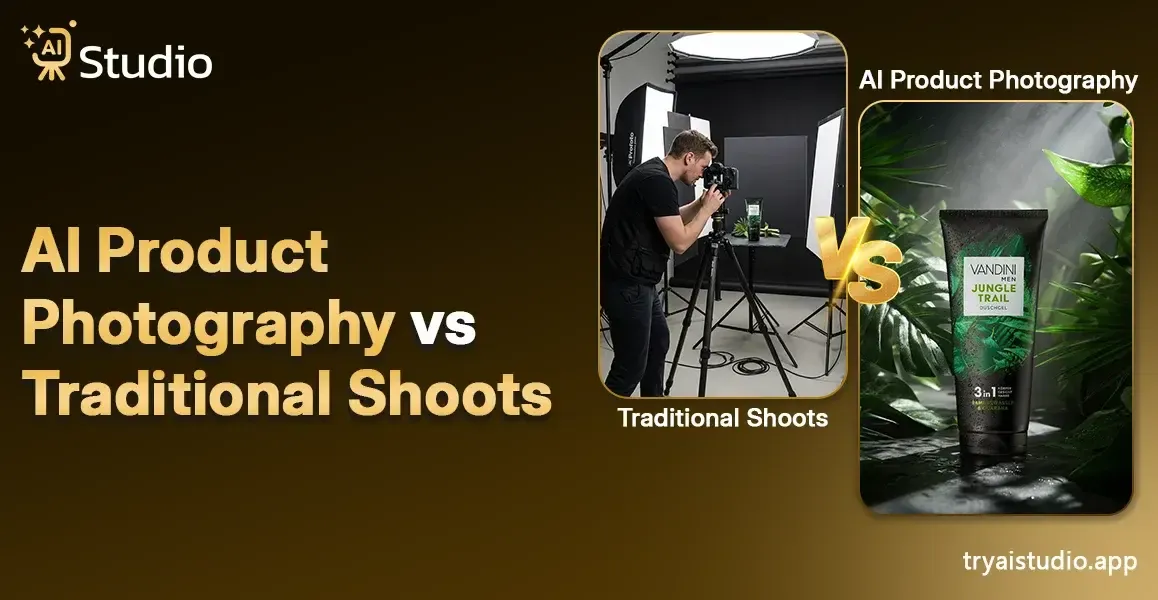
AI product photography applies directly to its name because it involves taking pictures of products which will be used for selling purposes. Products become appealing to consumers through product photography which transforms basic items into desirable merchandise through its application of product photography.
Great photos of products demonstrate their appearance through several features which establish trust between customers while creating product desire and performing the same functions of a salesperson who works in a store. The AI product photography becomes essential for shoppers who lose the ability to touch or test a product which they want to buy.
Why Good Visuals Matter in 2026
In 2026, the average online shopper sees hundreds of product listings every week. Studies show that 93% of buying decisions are influenced by visuals. If your product image looks dull, blurry, or cheap, the shopper moves on usually within two seconds.
Platforms like Instagram, TikTok Shop, and Amazon have become brutally competitive. A product with mediocre photos simply doesn't convert, no matter how good the actual item is. Visual quality has become an essential revenue driver which businesses need to maintain.
Rise of AI in product photography
You will find your answer at this specific location. The complete field of product photography now faces difficulties from AI tools which started their emergence two years ago. Brands can now achieve instant results by uploading product images which AI technology uses to create professional-grade scenes instead of waiting one week for edited shots through traditional studio booking and prop transportation methods.
The technology has achieved rapid development since its beginning. Today, AI-generated product photos are being used by everything from solo Etsy sellers to mid-size D2C brands. The solution may seem beneficial but its effectiveness remains uncertain. The analysis will examine all components.
What is Traditional Product Photography?
Simple explanation
To create traditional product photography, you must employ a professional photographer and obtain a studio space or construct your own studio and then conduct the actual product photography work. The method which originated first remains in use today because it serves multiple beneficial purposes.
How traditional shoots work
The process usually goes like this: a brand reaches out to a photographer or creative agency, discusses the brief, ships the product, and schedules a shoot day. The shooting team creates lighting setups, arranges props, and captures thousands of photographs throughout the shooting day. The process begins with image selection which leads to retouching work before the final images are sent back to the client within a period of several days to one week.
A skincare brand prepares for its upcoming holiday campaign. The brand will hire a photographer, a prop stylist, a makeup artist for hand shots, and they will rent a studio for their entire day.
Equipment, studio, and team involved
A standard traditional shoot involves a professional DSLR or mirrorless camera, a full lighting kit (softboxes, reflectors, strobe lights), a studio space or location, a backdrop or set, and a retoucher working in Lightroom or Photoshop post-shoot. For larger campaigns, you might also have a creative director, a stylist, and a video crew.
What is AI Product Photography?
Simple definition
AI product photography uses artificial intelligence to create product images which it enhances and places into professional scenes without the need for any equipment including cameras and studios and photographers.
How AI generates product images
AI product photo tools use your current product image which usually consists of a basic smartphone photograph taken against a plain backdrop to generate real-world environments through their image generation systems. The AI system uses its understanding of product shape and light conditions and surface texture to produce realistic scenes which include wooden tabletops and sunny outdoor café settings and minimalist white studio environments.
Example: You upload a flat-lay shot of your candle. The AI places it on a marble countertop with soft morning light, a dried flower in the background, and a realistic shadow. The whole process takes under two minutes.
Popular AI tools used
In 2026, the leading AI product photography tools include Pebblely, Booth.ai, PhotoRoom, Mokker, and Adobe Firefly (integrated directly into Photoshop). The different tools display distinct advantages because certain tools excel at capturing lifestyle scenes whereas others perform better with studio environments. The majority of services provide subscription plans which begin at approximately $20 each month.
Key Differences Between AI vs Traditional Photography
Process comparison
Traditional shoots follow a linear, time-intensive workflow which includes five steps: brief → planning → shoot day → culling → retouching → delivery. AI photography creates a loop which operates with almost no delay between these three steps: upload → prompt or select a scene → download. The time and effort required show an extremely large difference between the two activities.
Quality and creativity
The situation becomes complicated at this point. Skilled photographers use traditional photography techniques to create pictures which show genuine human emotions. The precise reproduction of actual light and actual textures together with human artistic choices remains an unattainable goal.
The field of artificial intelligence has achieved substantial progress since its inception. The visual quality of standard e-commerce shots which include white backgrounds and clean studio appearances and basic lifestyle scenes becomes unrecognizable to most shoppers.
Artificial intelligence struggles to handle three specific situations which include complex multi-product environments and action sequences and situations which need authentic human behavior.
Flexibility and customization
AI wins here, hands down. The product can be shown in ten distinct settings exactly as requested. The benefits of AI product photography needs one version while Japan requires a different version. Traditional photography requires businesses to conduct new photo shoots whenever they want to capture fresh scenes because these shoots demand additional expenses and extended time. AI enables users to create new versions of their work immediately after they generate new concepts.
Cost Comparison (AI vs Traditional)
Cost of hiring photographers and studios
A professional product photographer in the US typically charges between $500 and $3,000 for a half-day shoot, depending on their experience and location. The cost of studio rental without exception ranges from $200 to $800 per day. A proper campaign shoot requires at least $5,000 in expenses which will increase to $15,000 or more when you include costs for a stylist and retouching and fast delivery services.
Cost of AI tools and subscriptions
benefits of AI product photography have a price range that makes them accessible to most users. The majority of platforms offer monthly subscriptions which cost between $20 and $100 for their unlimited or high-volume image generation services.
Some services implement a pricing model which charges customers per image at rates that vary between $0.10 and $2 based on the image's resolution and difficulty to produce. A startup can generate hundreds of professional product images for the cost of a single studio hour.
Cost comparison table
| Item | Traditional Shoot | AI Photography |
|---|---|---|
| Basic shoot / tool cost | $500 – $3,000 | $20 – $100/mo |
| Per-image cost | $30 – $150 | $0.10 – $2 |
| Turnaround time | 3 – 7 days | Minutes – hours |
| Revisions | Expensive / slow | Instant / free |
| Scalability | Limited by team | Unlimited |
Hidden costs you should know
The two choices both include unexpected elements. The standard shooting process incurs concealed expenses which cover product-based reshoots and licensing charges for models or music used in video content and it requires additional time to complete complex scene retouching work.
Speed & Turnaround Time
Time taken in traditional shoots
The standard duration of a traditional shoot extends from initial contact to its completion which requires a time frame of one to three weeks. The process encompasses three stages which include three to five days of pre-production planning and one to two days of shooting and three to seven days of editing and retouching and feedback rounds.
How fast AI can generate images
AI product photography are delivered in minutes. You can create polished images which are ready for download within two minutes by uploading your base product photo and selecting a scene and adjusting a few settings. Most platforms let you batch-generate dozens of variations simultaneously. An afternoon is required to complete a 50-product catalog.
ROI (Return on Investment) Breakdown
What is ROI in product photography?
In this context, ROI means the revenue or business value you get back relative to what you spent on your product images. The Difference between AI product photography vs traditional photography extends beyond expenses, measuring performance through conversion rates, brand perception, customer repeat purchases, and customer trust established over time.
How AI improves ROI
AI product photography vs traditional photography reduces operational expenses which organizations need to manage. The business becomes profitable when you invest 50 dollars monthly instead of 5000 dollars for each advertising campaign. A/B testing enables you to test various backgrounds and styles without incurring additional costs while discovering which option generates the highest conversion rates before selecting your complete creative style.
AI-generated images for e-commerce sellers on Amazon or Shopify platforms boost click-through rates because these images present a clean and uniform and professional appearance.
When traditional shoots give better returns
The return on investment from traditional photography for high-ticket products shows different results. A luxury watch brand selling $5,000 timepieces needs to maintain a flawless appearance.
The buyer needs to see the actual light which reflects from a metal bracelet and the actual depth of the real leather strap because these details allow him to understand why traditional photography costs what it does.
The highest quality for brand campaigns and editorial spreads and hero images which appear on billboards and homepage banners needs traditional photography because AI has not yet reached this standard.
Use Cases: When to Choose AI Photography
E-commerce product listings
This AI product photography vs traditional photography represents the optimal functioning area for AI photography technology. The image requirements for marketplace listings on Amazon Etsy Flipkart and similar platforms need sellers to use white backgrounds while showing products from different angles under proper lighting conditions.
Social media content
Social platforms demand volume. Fresh visual content needs to be produced by you every week and at times every day. AI enables small teams to produce lifestyle images which they use for their Instagram and Pinterest and TikTok content calendars without needing to conduct traditional photo shoots.
A food supplement brand, for instance, can generate 30 different contextual product shots (gym bag, morning kitchen scene, outdoor hike) in a single session.
Startups and small businesses
For businesses in their early stages, professional photography might be financially out of reach. The artificial intelligence technology enables these businesses to establish a professional appearance which matches their larger competitors while maintaining budget constraints. The system functions as a true market equalizer.
Use Cases: When Traditional Shoots Are Better
Luxury and high-end brands
For businesses in their early stages, professional photography might be financially out of reach. The artificial intelligence technology enables these businesses to establish a professional appearance which matches their larger competitors while maintaining budget constraints. The system functions as a true market equalizer.
Complex product setups
Traditional photography maintains its superiority when your product requires multiple components and human users and specific operational contexts that need complete real-world testing. AI encounters difficulties when it needs to create realistic human representations and authentic artistic direction for multi-object scenes.
Brand storytelling and ads
When you need to tell a story a campaign that evokes emotion, a narrative that positions your brand in the world traditional photography (and videography) is irreplaceable. The authentic portrayal of actual moments and actual people who exist within actual environments establishes a bond which artificial intelligence has not yet achieved at widespread usage.
Pros and Cons of AI Product Photography
Advantages
- Speed: Generate professional images in minutes, not days
- Cost: Affordable subscription models accessible to any budget
- Scalability: Produce hundreds of variations without proportional cost increases
- Flexibility: Instant restyling for seasonal campaigns, regional markets, or A/B tests
- Consistency: Uniform lighting and presentation across an entire catalog
Limitations
- Authenticity ceiling: Real light on real products still has a quality edge for premium use cases
- Complex scenes: Multi-product setups and human interaction remain difficult
- Brand risk: Over-reliance on AI can result in images that look generic or similar to competitors
- Input dependency: The quality of your base product photo directly limits what AI can produce
- Regulatory uncertainty: Some platforms and regions are beginning to require disclosure of AI-generated images
Pros and Cons of Traditional Photography
Advantages
- Authenticity: Real lighting, texture, and emotion are still unmatched for premium applications
- Creative control: A skilled photographer brings ideas, perspective, and artistry
- Versatility: Handles complex setups, models, and action scenes effortlessly
- Brand differentiation: Unique, original photography is harder for competitors to replicate
- Trust: Luxury consumers and editorial buyers still respond more strongly to evidently real photography
Limitations
- Cost: Significant upfront investment, especially for campaign-scale production
- Time: Weeks from brief to delivery; not suitable for reactive or fast-turnaround needs
- Scalability: Producing catalog-scale imagery traditionally is expensive and logistically demanding
- Rigidity: Changes require reshoots; you can't easily swap a background or resize for a new platform
Future of Product Photography
Not complete yet because it will take more time to achieve full results. The current AI technology performs background generation and simple lifestyle scenes and catalog photography and quick social content creation. The system automates repetitive tasks which form the bulk of commercial photography work.
The essential duties performed by professional photographers who excel in their field require both strategic planning and creative work and emotional intelligence capabilities. The most successful brands in 2026 operate with AI systems that manage their high-volume operations while allocating human resources to essential marketing campaigns.
Conclusion
Which one should you choose? The honest answer is simple: it depends on your product, your budget, and your goals. The two methods of AI product photography and traditional photography lack a superior option because each method serves as a tool which matches specific tasks which need to be performed.
benefits of AI product photography who operate e-commerce enterprises with limited resources should implement AI photography because they need to manage extensive product catalogs and create social media content which requires immediate delivery. The solution provides financial savings together with exceptional quality which exceeds basic requirements and delivers operational speed benefits to businesses which need to increase their growth rate.