


Best Photo Editing AI Tools for Product Photography 2026
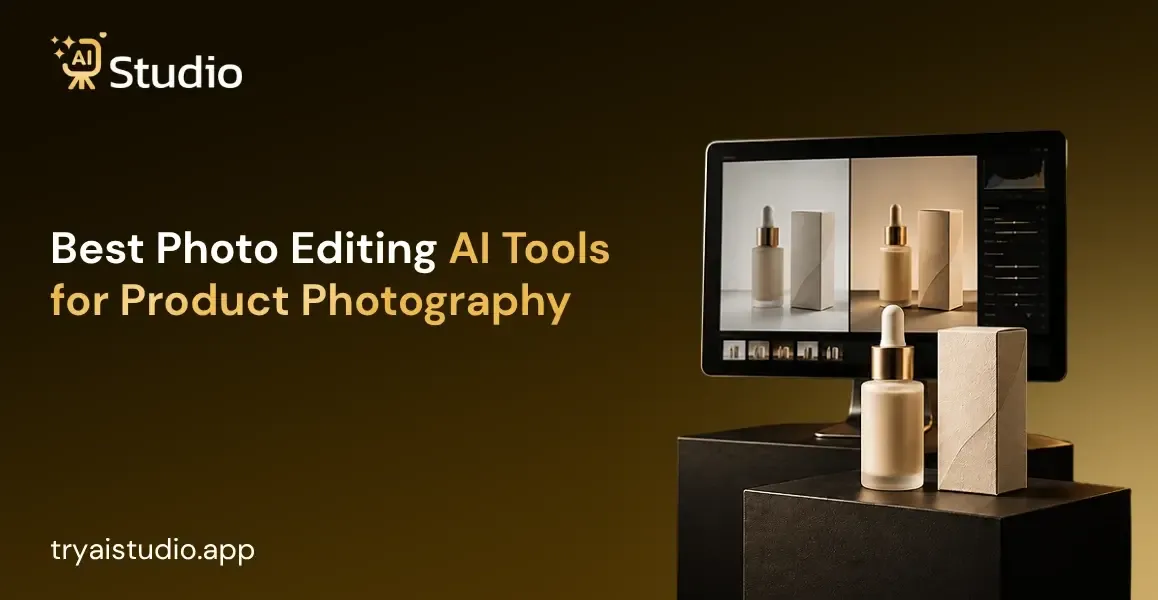
If you sell on Amazon, Flipkart, or Shopify, you know how frustrating it can be when your product has great features and pricing, but the images fail to attract potential buyers.
This is where AI photo editing software can help Indian ecommerce businesses create better product images faster.
I have seen many small business owners struggle to photograph their products because of limited budgets, tight schedules, and a lack of professional equipment. These businesses often find that their product images fail to represent the actual quality of their products. AI photo editing software is helping businesses address these challenges in 2026.
In this article, you'll learn how businesses are using AI for product photography, which tools are worth considering in 2026, and how you can use them even without professional design skills.
What is AI Photo Editing for Products
In simple terms, AI photo editing software uses artificial intelligence to enhance, modify, or recreate product images without requiring professional cameras, lighting, or studio equipment.
Simply upload your product image, and the AI image editor handles much of the editing process for you.
This can save significant time and effort. Instead of hiring a photographer, you can create product images in seconds, even without professional photography skills.
An AI image generator analyzes your product image and places it into a new background or environment.
Here's what a good AI image editor can typically do:
- Remove or replace the background instantly
- Generate studio-style lighting and shadows automatically
- Create lifestyle scenes (a candle on a table, a bag on a model's shoulder)
- Fix color accuracy so the product looks true to life
- Produce multiple angles or variations from a single photo
(Insert product photography example here, show a raw phone photo next to an AI-edited version) Alt text suggestion: "AI photo editing software before and after product image comparison"
I have often seen sellers struggle to find the right solution for product photography. One common misconception is that high-quality product photos require expensive professional equipment. Fortunately, this is where the idea of this article comes in.
Here's a real-world example. One jewelry seller told me that she used to photograph her rings and earrings on a white bedsheet using her phone. She then edited the photos with a photo editing app, trying to make the lighting as good as possible.
The results were not satisfying, and she could not afford a professional photoshoot. However, as soon as she started using an ai product image generator, the AI generated clean product images that matched the look she wanted.
This is what the product image generator is for. It allows the seller to present their products just as well as a professional photo would, without actually spending money on a photoshoot.
AI vs Traditional Product Photography
Traditional photography still makes sense for large brands and campaign shoots. However, for many small and mid-sized sellers, it can be more expensive and time-consuming. Here's the real difference between AI and traditional product photography, side by side.
| Factor | Traditional Photography | AI Photo Editing Software |
|---|---|---|
| Cost | ₹10,000 to ₹50,000 per session, roughly ₹1,250 per image on a 20 product shoot | Starts at ₹600 per month, covers dozens of images, new products cost nothing extra |
| Turnaround Time | A few days to two weeks (booking, shooting, editing) | Seconds, upload and download the same minute |
| Consistency | Often varies session to session as lighting and angles shift | Same settings applied every time, entire catalog looks uniform |
| Scalability | Limited by photographer availability and studio bookings | Unlimited, generate as many variations as you need anytime |
| Image Quality | Depends heavily on photographer skill and equipment | AI-generated product image quality has improved a lot, with natural shadows and lighting when using a solid tool |
| Best For | Hero shots, campaign-level content, big-budget brands | Everyday listing images, fast catalogs, small businesses |
The short version: traditional shoots still win for big hero campaigns, but for day-to-day listing images across Amazon, Flipkart, and Shopify, AI product photography is faster, cheaper, and far easier to keep consistent across a growing catalog.
Best AI Photo Editing Tools for Product Photography in 2026
Let me give you a tour around the AI photo editing tools currently available that you might want to consider. I've organized them by what you, as a seller, need to be able to do, not by what sounds cool in a marketing blurb.
Try AI Studio
I'll be upfront: this is the tool I recommend most to Indian sellers, and there's a clear reason for that. AI Studio was built with Indian ecommerce sellers in mind, not adapted from a global tool after the fact.
Plans start at just ₹600 per month, which is roughly the cost of a single prop rental at a traditional studio. You get free HD downloads with no watermark, and it works across more than 30 product categories, including fashion, jewelry, accessories, gadgets, and general ecommerce listings.
What makes it genuinely useful for Indian sellers:
- No studio or equipment needed at all
- Studio-quality images generated in about 10 seconds
- On-model fashion photos without hiring an actual model
- Built for Amazon, Flipkart, Shopify, and Instagram ad formats
- Consistent, on-brand results across your whole catalog
I have seen businesses leverage AI Studio to create consistent images of products without involving models, which is an advantage to D2C fashion sellers who cannot afford to hire models for every product launch. One seller mentioned how his e-commerce click-through rate (CTR) improved after he stopped using unclear phone-clicked photos and started using AI-generated images. Many sellers prefer to spend ₹20,000 on an AI image generation tool like AI Studio rather than spend that money on a model for a photo shoot.
This is also a genuinely useful AI photoshoot for Amazon sellers who are juggling dozens of SKUs and simply don't have the time to coordinate individual shoots for each one. You upload your product photo, pick a theme that matches your brand, and within seconds you have a listing-ready image. For agencies handling multiple client accounts, this same workflow scales easily, since you're not limited by a photographer's calendar or a studio's booking slots.
What stands out to me most is how it handles the categories that are usually the hardest to shoot well. Jewelry, for instance, needs precise lighting to avoid harsh glare or dull reflections, something that trips up even some professional photographers. Fashion needs believable draping and proportion if you're generating on-model shots. AI Studio was clearly built with these specific Indian seller categories in mind, rather than being a generic tool retrofitted for ecommerce.
Claid
This tool is designed for larger international catalogs that require batch image processing, background removal, scene generation, and virtual models; remove backgrounds, scene generate, create virtual models and outfits for fashion retailers.
The main limitation for Indian sellers is the pricing and scalability. The tool appears to be better suited to high-volume enterprise customers with larger budgets. So for smaller sellers managing around 100 SKUs, the cost may be difficult to justify compared with more affordable alternatives.
Photoroom
Photoroom is a solid, mobile-friendly option, especially known for its ecommerce photo background remover AI feature. It's fast and works well if all you need is a clean white background for a marketplace listing.
However, it may not be suitable for sellers looking for ghost mannequin support or multi-angle generation from a single image. Its pricing is also listed in US dollars, which can make budgeting more difficult for Indian sellers.
Pebblely
Pebblely is good for quick, background-driven image generation. If you just need a fast lifestyle backdrop for a single product shot, it does the job reasonably well.
The limitation here is depth. It doesn't support fashion or on-model photography, and sellers managing a full catalog across multiple categories often find themselves needing a second tool to fill the gaps.
WeShop AI
WeShop specializes in on-model AI fashion photos without model generation, which is great if your entire catalog is clothing. Flair, a similar tool in this category, focuses more on lifestyle scenes for home and skincare products.
The trade-off is that these tools have a narrower focus. If your store sells a mix of fashion, accessories, and gadgets, you'll likely need to combine two or three separate subscriptions just to cover everything, which adds cost and complexity you don't need.
How to Improve Amazon and Flipkart Listing Images with AI
Let's look at how to improve Amazon listing images in practice. Any experienced seller will tell you that a proper image optimization checklist usually involves a few key rules that marketplaces impose, regardless of whether you shoot them with AI or a real camera.
Your Amazon main image must follow Amazon's current image requirements. For many product categories, the main image uses a white background. Always check Amazon's latest category-specific guidelines before uploading. Most tools for AI product photography, including AI Studio, have a specific mode to make this easier.
Finally, make sure not to add any text, watermarks, or promotional banners to your main image. Counterintuitively, this kind of "creative" use of the space is one of the most common mistakes that sellers make when designing their main image, while you want to use your product imagery to tell a story, your lifestyle shots with text, watermarks, banners, or other elements should be saved for your additional images.
A few more product photography tips for sellers worth remembering:
- Use secondary images to tell a story (in-use shots, close-ups, size comparisons)
- Keep your background style consistent across all products in the same category
- Test different angles to see which ones actually improve your click-through rate
- Update older listing photos periodically, especially if your packaging or branding has changed
I've noticed that sellers who treat their photos as an ongoing part of their store, not a one-time task, tend to see steadier growth over time. Your listing images are essentially your storefront window. Would you walk past a dusty, poorly lit shop window? Probably not, and neither will your buyers.
Here's another thing worth mentioning. Flipkart's catalog guidelines are quite similar to Amazon's when it comes to background and clarity, but Flipkart also places extra weight on lifestyle context images for certain categories like fashion and home goods. This is where a Shopify AI image generator or similar ecommerce-focused tool becomes genuinely useful, since it can produce both the compliant white background version and a styled lifestyle version from the same original photo, without you having to plan two separate shoots.
If you're managing listings across Amazon, Flipkart, and your own Shopify store at the same time, keeping image formatting consistent across all three can get confusing fast. A simple habit that helps is creating a short checklist for yourself before uploading any new listing image, covering background type, resolution, and whether text or branding elements are allowed for that specific slot on that specific platform.
Free vs Paid AI Product Photography Tools
This is a question I get asked constantly, so let me break it down honestly.
Most free AI photo editor online tools give you basic background removal and maybe one or two preset scenes, a decent starting point if you're just testing the waters. Some platforms also offer an AI product photo generator free trial to check quality before you commit. But free tiers usually come with real limits:
- Watermarks on downloaded images
- Lower resolution exports
- Limited scene or background options
- No support for on-model fashion photography
- Restricted number of monthly generations
Paid plans, like AI Studio's ₹600 per month starting tier, remove all of this. You get full HD downloads with:
- no watermark
- more categories and themes
- enough monthly generations to actually run a growing catalog
My honest take: start free if you're testing one or two products. But once you're managing a real catalog with regular updates, a paid plan usually pays for itself in the first month alone.
Conclusion
Product photography need not be an expensive and time-consuming process that delays your launch. Whether you are an independent Shopify seller, a D2C fashion label looking to scale, or an agency managing multiple catalogues, AI photo editing software is a faster, cheaper, and more efficient way to get your listing photos ready.
From cutting down on studio costs to speeding up image generation for Amazon & Flipkart, the switch to AI-generated images is underway in the Indian ecommerce space. To experience the difference, simply create your first image with AI Studio in under a minute!