


AI Product Photography vs AI Image Generators: What's the Difference?
Introduction
If you are an e-commerce seller in India, you must have used some AI tool to generate product photos. But you might be surprised to see that the image generated by an AI tool differs drastically from the actual product. You tried using another AI product photo generator, uploaded the image, and within seconds, you got a realistic image of your product. The same AI tools were used, but the output was different.
Such are the primary reasons why many product sellers these days get confused between AI Product Photography tools and AI Image Generators.
Many product sellers, especially D2C brands and apparel sellers, do not have a budget of ₹20,000 – ₹50,000 for hiring a photographer and a studio every time they need pictures of their products. In this article, I will discuss everything you need to know regarding AI Product Photography, what it is, what it does, and how it differs from AI Image Generators.
What Is AI Product Photography?
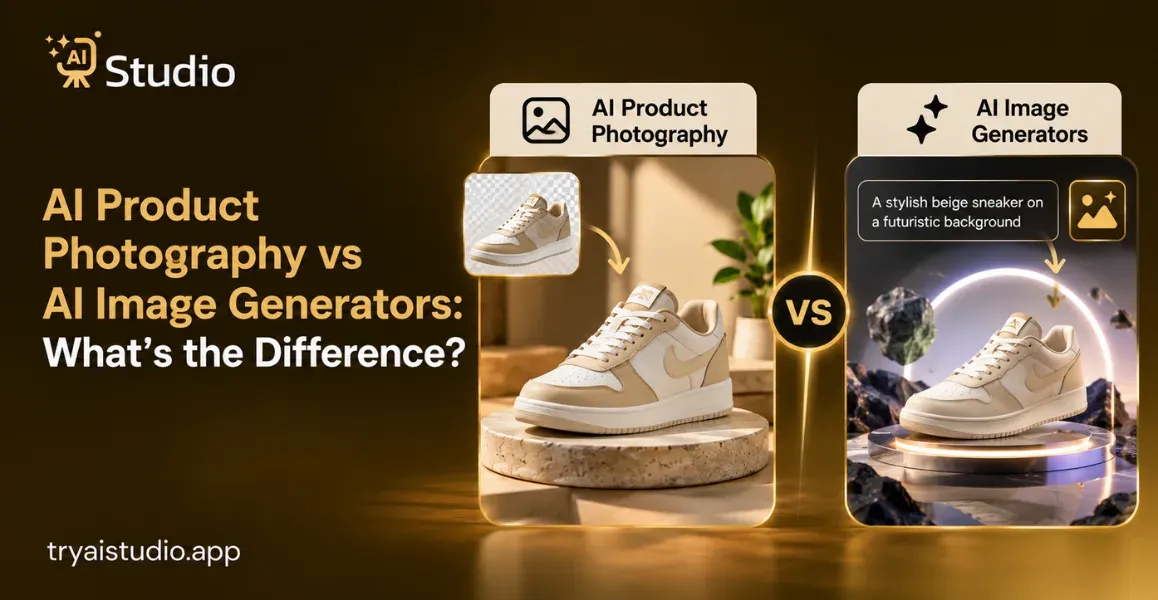
Let me try to explain this in my own words. AI product photography refers to utilizing an AI tool that allows you to manipulate the background, lighting, or other attributes of the actual product image. It doesn't create your product; instead, it works with you to edit the existing media. If you want a deeper explainer, see what is AI product photography.
How AI Product Photography Works
Think of it as a case: you take a casual shot of your kurti or a product piece on a white background at home using your phone. You send it through product photography AI software.
- The tool removes the background automatically
- It adds a new background, like a studio setup, a lifestyle scene, or a plain colour backdrop
- It adjusts lighting and shadows to make it look professional
- You get a finished, listing-ready image in seconds, not days
This is basically what good AI product photography tools do behind the scenes.
What It's Good At
Here's the reality. AI product photography software is excellent when you need:
- Consistent backgrounds across your entire catalog
- Multiple scene variations from one product photo
- Fast turnaround for new arrivals
- Lower cost compared to hiring a photographer and studio
Many AI product photography tools for ecommerce are tailored to Amazon, Flipkart, and Shopify sellers looking to avoid the costs of a shoot while remaining within the bounds of the guidelines of the given portal.
What Are AI Image Generators?
Now we can talk about the other side. AI image generators are completely different in that you do not upload an image of your real product, but instead describe it in text, and the AI creates a completely new image for you, which will represent your product.
Strengths
AI image generators are genuinely useful for:
- Creating concept images or mood boards before a real shoot
- Making ad creatives, banners, and social media graphics
- Designing characters, illustrations, or campaign visuals
- Generating ideas when you don't have a physical product yet
If you're a marketing agency brainstorming a campaign look, this kind of tool can save a lot of time.
Why They Struggle With Real Products
Here is the thing, and it is an important thing. Because the AI is imagining a product rather than you describing a product they are already seeing, there is potential for misinterpretation and mistakes.
So if you enter "Premium perfume bottle on marble counter with soft lighting," the AI may give you a beautiful image, but it will almost certainly not be accurate in terms of the product you are trying to sell. The shape of the bottle, text on the label, or even the color of the cap may be completely different from your product.
For AI-generated product images, this is a real problem, especially for:
- Jewellery with fine detailing
- Products with brand logos or text on packaging
- Clothing with specific prints or patterns
- Anything where customers expect exactly what they see
I've tested this myself many times, and the gap between "looks nice" and "matches my actual product" is where most sellers get caught out.
AI Product Photography vs AI Image Generators: Key Differences
Let me show you the difference side by side, because this is really the heart of the whole product photography vs AI image generator debate.
| Factor | AI Product Photography | AI Image Generators |
|---|---|---|
| Starting point | Your real product photo | Text prompt or idea |
| Product accuracy | High, product stays true | Often inaccurate |
| Catalog consistency | Strong, same product every time | Weak, varies each generation |
| Speed for bulk listings | Fast for many SKUs | Slower, needs manual checking |
| Best use case | Ecommerce listings | Ads, concepts, campaigns |
| Skill needed | Minimal, just upload | Prompt writing skill helps |
The Core Difference in One Line
If I had to put it in one sentence: AI product photography edits reality, while AI image generators create imagination.
Accuracy and Trust
This is more important than most people think. When a customer clicks a link on your Amazon or Flipkart post, they want exactly what's in your image to appear before them.
Using an AI image generator for products can result in you receiving returns or bad reviews if something isn't right.
Which is better: AI product photography or AI image generator? It's hard to say one is better than the other. It all depends on what you're trying to accomplish.
Can AI Image Generators Create Product Photos?
Short answer: yes, but with a big reservation. AI image generators can create product-type images, but for actual product listing photos, it's a gamble to get the details right.
When a Generator Works
- Making ad creatives around a concept
- Testing a packaging idea before production
- Creating a lifestyle mood for a product that doesn't exist yet
- Building social media content that doesn't need exact product accuracy
When It Fails
- Products with small text or exact labels
- Jewellery pieces with fine stone or metal detail
- Clothing where fit, size, and print must be accurate
- Any listing where the customer compares the photo to the delivered item
Marketplace and Labeling Considerations
Here's something many sellers overlook. Amazon and Flipkart have image guidelines that state that your listing photos should depict the product accurately.
By using a generic AI ecommerce image generator that creates products out of thin air you could end up violating these very guidelines and get your listing flagged.
There is also a global movement to label synthetic images, so it's important to stay up to date with the policies of the platforms you are selling on before using any image generation tools for your live listings.
Which Should You Use for Your Ecommerce Store?
This is what actually interests sellers, so let's discuss different scenarios.
Large catalog with thousands of different SKUs: Use AI product photography tools to make sure that the backgrounds and lighting are consistent across hundreds of products.
Launching a single hero product: A combination of a real photo and an AI-generated background will help you present your offering most effectively.
Creating ad creative or a campaign banner: Using AI image generators is an acceptable option here, as there's no need to focus on product detail.
Fashion and jewellery brands: Focus on using product photography AI to achieve the best possible quality, as customers shopping in this category are especially particular about the items' appearance. Brands that want on-model fashion shots without hiring models can explore this route too.
Startups with a limited budget: Consider using an affordable AI product image generator tool to design images for social media posts and product pages instead of investing in a professional photoshoot.
A Simple Hybrid Workflow
In my experience, the smartest sellers don't pick just one. They photograph the real product on a phone and use AI product photography to generate clean, professional scenes for listings and only use a general image generator for campaign concepts that require pure concepts, not real product shots.
Instead of spending ₹15,000 to ₹30,000 to create a complete shoot with a studio and models, many Indian sellers now take advantage of tools like AI Studio to transform a simple photo from their phone into a complete studio shoot in ~10 seconds.
I've seen fashion and jewellery brands use AI Studio to create consistent product images without having to book models and rent a studio space, and at ₹600 a month, it ends up costing way less than a single traditional shoot.
This approach works well for fashion, jewellery, accessories, general ecommerce listings, and social media ad creatives as you can count on consistent, real product-based results every time instead of concepts based on a prompt.
Conclusion
In short, whether your requirement is AI product photography or image generator depends on your use case. You should go for an AI product photography service if you need accurate and reliable images of your products for Amazon, Flipkart, or Shopify.
If you require campaign concepts or images that do not have to be precise, you can use an image generator.
Most of my clients who work with both find that using both services for different purposes provides the best value for money.