


Best AI Ecommerce Automation Tools in 2026 (Real Results)
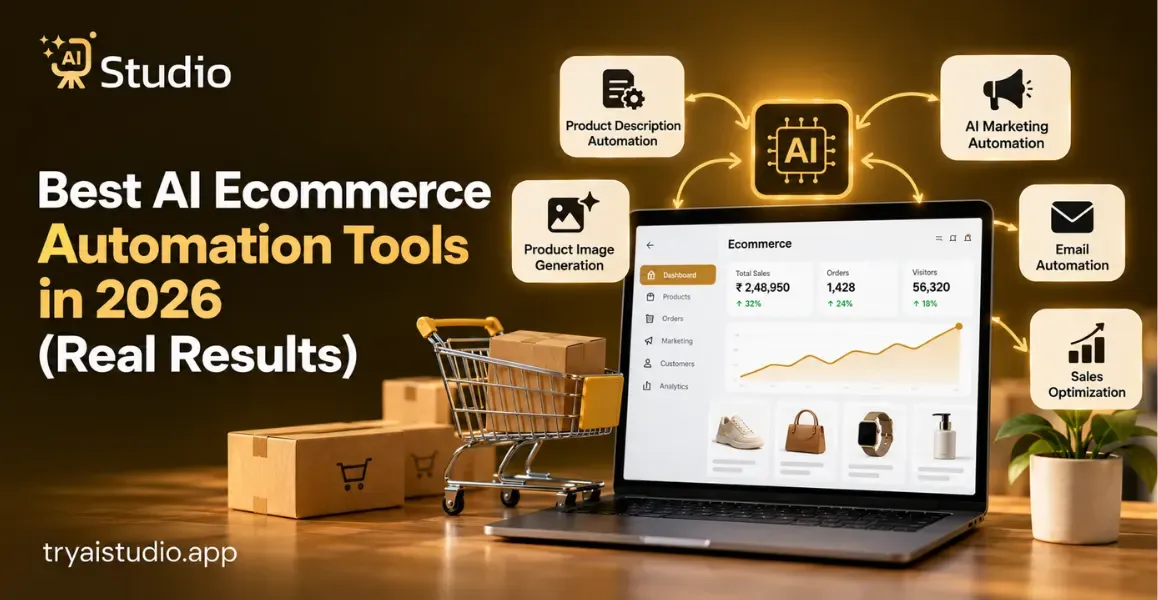
Running an online store involves repetitive tasks that are not only dull but also consume a lot of time. Shooting photos, responding to customers, email marketing campaigns and tracking inventory.
If you sell your products on Amazon, Flipkart, Meesho or your own Shopify store, you know how easily this can devour your day.
This is where AI ecommerce automation tools come in and in 2026 is simple enough to use that small sellers can adopt without a tech team.
In this guide, I will break down the AI ecommerce automation tools worth investing in, task by task, with limitations and costs in ₹, to help you decide what you need, and what you don't.
Here's a snapshot of the AI ecommerce automation tools covered below. Prices fluctuate frequently, so be sure to check out each website.
| Job | Tool | Starting price |
|---|---|---|
| Product photos | AI Studio | ₹600/month |
| Customer support | Gorgias | Check current plans |
| Email and SMS | Klaviyo | Check current plans |
| Store AI assistant | Shopify Sidekick | Included with Shopify |
| Inventory planning | Inventory Planner | Check current plans |
What Are AI Ecommerce Automation Tools?
AI ecommerce automation tools are programs that perform repetitive tasks for your store, such as writing product descriptions, image creation, responding to buyers, forecasting inventory, and more. They are different from traditional rule-based software as they can learn and improve their performance based on the data they process.
AI Automation vs Rule-Based Automation
Let me explain this in a simple way. Rule-based automation follows a fixed pattern: if a customer places an order, send a confirmation SMS. It never changes unless you change it.
AI ecommerce automation works differently. It looks at patterns, like which customers buy again or which products sell out fast, and adjusts on its own. Think about it this way: rule-based is a checklist, while AI is an assistant who slowly learns how your store runs.
What Changed in 2026
Here's the thing about Shopify: the platform already embraces AI, including Shopify Magic and Sidekick. As such, utilizing AI for basic and generic tasks, like description or background edits, is no longer a priority.
That said, ecommerce AI tools must be able to serve a specific purpose. Based on my own experience, the most effective and long-lasting AI tools are those that offer automation for a particular task, like image editing or customer support.
How We Tested These Tools
I never trust a list that only repeats what a tool's website says. So here is how I judge every tool in this guide, from the point of view of a small seller with limited time and money. Good AI ecommerce automation tools should feel easy from day one, not like a second job.
- Ease of setup: can a beginner start in an hour without a developer?
- Integration: does it connect with Shopify, Amazon, Flipkart or your marketplace panel?
- Time saved: how many hours does it give back every week?
- Cost: is the price fair for a seller earning a few lakhs a month, not a big brand?
- Measurable result: can you see the change in orders, clicks or support tickets?
For photo tools, I run a simple test. Upload three different products, like a kurta, earrings, and a handbag. Then note how long each image takes and whether the look stays consistent across the set.
Best AI Ecommerce Automation Tools by Job
Now for the good part! I've sorted these AI ecommerce automation tools by job type, as that's how most people will be looking. Simply pick the most pressing job for you (or your team) and start now! Before you pick, you can also read our ecommerce guide to AI product photography.
AI Product Photography and Visual Content
Photos determine if a buyer will click on your ad or move on. The truth about a good product shot in India is that it costs between INR 10,000 and 50,000, including the studio, model, photographer, and editing.
Small sellers typically only shoot a few items every month.
This is where AI product photography has changed everything. With tools like AI Studio (tryaistudio.app) anyone can upload an image of the product, select a theme, and get a studio-quality image in about 10 seconds flat.
There is no need for a model or even a studio! It works well for fashion, jewelry, accessories, and even for ecommerce listings. The images are watermark free.
A good product image generator is a must-have for ads and social media posts since it maintains the same look and feel.
Best for: fashion, jewelry, and accessories sellers on Amazon, Flipkart, and Shopify
Starting price: AI Studio plans begin at ₹600/month
Limit: check small details like stones, prints, and logos before you upload
Pixelcut is another popular option, so try both side by side with the same product. For a closer look, see this comparison of AI product photo apps.
AI Customer Service for Ecommerce
Most of the frequently asked questions are the same: where is my order, how do I return this, is this available in my size. With AI customer service for ecommerce, these questions can be answered right away, even at 11 pm, leaving only the difficult ones for you to solve. Gorgias is a helpdesk software for online stores. A lot of Indian shoppers use WhatsApp to chat with stores, so make sure your customer service tool allows that too.
Best for: stores getting the same questions every day
Limit: angry or unusual cases still need a real person
AI Inventory Management and Forecasting
Stockouts result in loss of sales, while overstock ties up working capital. AI inventory management tools analyze historical sales data, seasonal trends, and supplier lead times to recommend reorder quantities.
Inventory Planner is one such tool that sellers use to predict their requirements. Think about it this way: before Diwali, a good forecast will tell you which size of the kurta is going to sell out before you place the next supplier order.
Best for: stores with many SKUs and seasonal demand
Limit: it needs clean sales data, so tidy your SKU list first
AI Product Recommendations and Shopify Built-In AI
Start with what Shopify already gives you. Sidekick helps with store tasks, and Shopify Magic works as an AI product description generator and can help with background edits. For AI product recommendations, quiz apps like Octane AI suggest the right product after a few shopper answers. This is where Shopify AI automation helps small stores most, since setup is light and you do not need a developer. Our Shopify product image AI tool guide covers the visual side in more detail.
Best for: Shopify stores that want quick wins
Limit: built-in tools cover the basics, not advanced needs
AI Agents and Workflow Automation
Ecommerce AI agents do a chain of tasks across apps. For example, they can read a new order, check stock, message the customer and update your sheet. This is powerful for ecommerce workflow automation, but honestly, it can be overkill. Among all AI ecommerce automation tools, agents are the most advanced, so add them only when your team keeps copying data between apps all day. When you compare ecommerce automation software, pick one that connects with the apps you already use.
Real Results: What to Expect and Common Mistakes
I need to be absolutely clear. These AI tools are NOT a magic solution for a poorly performing product or listing. They will save you time and money, and help your listings look their best if used correctly.
Results You Can Measure
Only trust numbers you can check in your own dashboard, whichever AI ecommerce automation tools you use.
- Time saved: hours per week on photos, replies, and emails
- Cost per image: compare the ₹ per photo from a shoot and from AI
- Ticket resolution: how many support questions get solved without a human
- Email revenue: sales coming from automated flows
Here is a simple example. A ₹20,000 shoot covering 20 products works out to ₹1,000 per product, before editing. A ₹600/month plan changes that math a lot. Treat this as an estimate, not a promise. You can see a fuller breakdown in this guide to AI product photography cost in India.
Mistakes to Avoid
- Automating before fixing your offer and pricing
- Installing too many AI ecommerce automation tools at once
- Skipping A/B tests on images and subject lines
- Publishing AI output without a human check
I've seen sellers sign up for five tools in one week and use none. Many AI tools for ecommerce offer free trials, so test one first.
Where AI Still Falls Short
Even the best AI ecommerce automation tools currently have limitations, so brand voice is something to be aware of since the AI copy may sound too generic. Also, some customer support scenarios are too nuanced to be handled by chatbots, such as a package that arrived damaged with a complicated refund procedure.
Always zoom in on product images before uploading them to see if there are any details such as stitching, stones on jewelry or text on packaging that could be mistaken for defects. And while tools like AI Studio provide excellent results, always take an extra two minutes to review them to avoid negative returns. Our notes on AI generated product images quality explain what to check.
How to Build Your AI Stack by Store Size
Not every store needs the same setup. The smartest AI tools for online stores match your size, and good AI ecommerce automation tools grow with you instead of forcing you to start over.
- Solo seller: one photo tool like AI Studio plus Shopify's built-in AI. That covers listings and basic copy for very little money. If you are just starting out, read about AI product photography for small businesses.
- Growing store: add email automation and a support bot, so repeat sales and replies run on their own.
- Scaling brand: add stock forecasting and recommendations, then look at agents to connect everything.
Whatever your size, the right AI tools for ecommerce businesses are the ones you will actually use every week. Many ecommerce automation tools sound exciting, but the simple ones win.
Conclusion
In short, the best AI ecommerce automation tools can save you hours and money, but you have to start small. Choose one task to automate, whether that be photos, customer support or emails, and then track the impact for 30 days.
If product images are your main pain point, try AI Studio at tryaistudio.app and witness one basic product photo transformed into a studio image in around 10 seconds. No studio, no models, no big budget. Just take it one step at a time and let your store reap the rewards.