


AI Virtual Models vs Real Models for Product Photography: Which Is Better?
Quick Summary
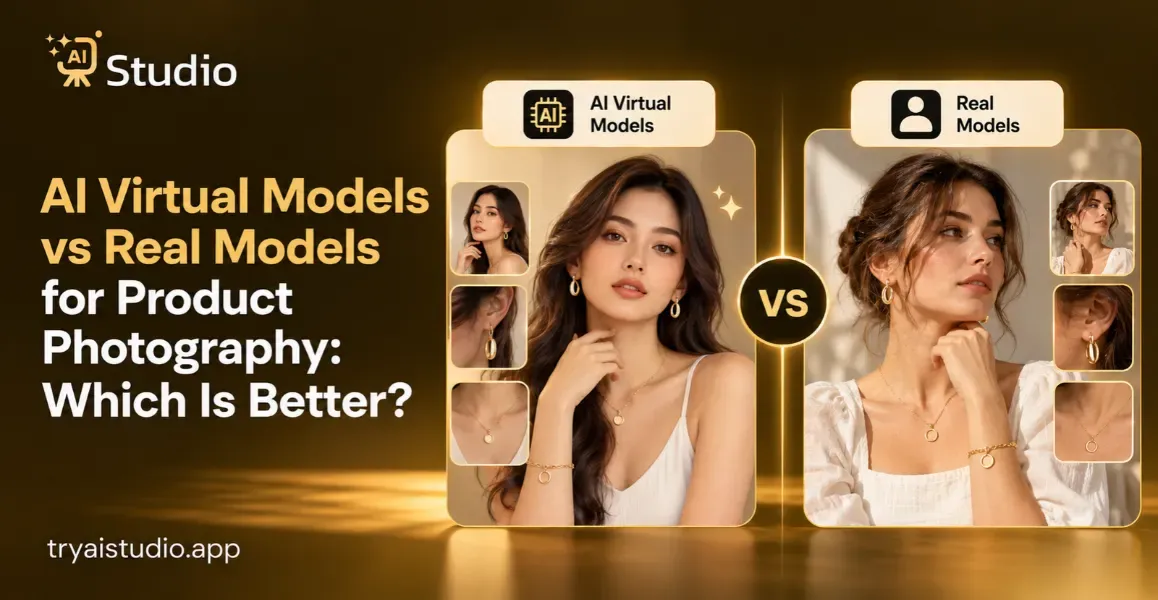
So, which is better: AI virtual models or real models?
For most ecommerce fashion catalogs, AI virtual models are the better everyday choice. They're faster, far cheaper, and consistent across hundreds of products. For hero campaigns, luxury storytelling, and fabrics that depend on real movement, real models are still the stronger option.
My honest answer is that I don't pick one. I use AI for product pages and volume, and I'd keep real models for the handful of images that carry the brand.
Key Highlights
- Cost: A traditional on-model shoot can run into tens of thousands of rupees per session. AI model photography typically costs a small fraction of that, and Try AI Studio plans start at ₹600/month.
- Speed: A traditional shoot takes days to weeks. AI on-model images take seconds to minutes per image.
- Consistency: AI keeps the same lighting, background, and style across your whole catalog. Real shoots vary from day to day.
- Realism: Today's AI-generated fashion models are realistic enough for most ecommerce listings, but delicate fabrics and close-up details still need a careful eye.
- Limitations: AI can struggle with complex drape, tiny text, intricate embroidery, and anything that depends on real motion.
- Best approach: A hybrid model. Use AI for product detail pages, new arrivals, and testing. Use real models for campaigns and flagship launches.
Why I Started Comparing AI Virtual Models and Real Models
If you sell clothing online, you know the challenge. A flat-lay picture of your product will not do. Modern clients want to see what the product looks like when worn, how it fits and sits on a person's body.
This means scheduling photographers, models, and studio time. Sometimes you need a stylist and a hair and make-up artist. It is not feasible for a clothing brand that only has dozens of items to photograph this way. It becomes impossible for a brand that releases new collections every month.
Therefore, I set out to learn if using AI virtual models to replace real ones for product photoshoots is a viable choice or not. I analyzed publicly available budget breakdowns from various sources, read articles from both sides of the argument, and tested the quality of products photographed with the AI clothing model generator. This article contains my findings on the subject.
What Are AI Virtual Models?
AI virtual models are computer-generated people used to demonstrate clothing and accessories in product photos. The user uploads a photo of their product (flat lay or ghost mannequin), picks a look, and the AI puts it on a virtual model.
The user may also find different names for AI-generated model photos: AI fashion models, AI model photography, virtual fashion photoshoot, or AI on-model photography. All of these refer to the same technology that lets you create a model-wearing-the-product image without a physical photoshoot.
The reason I find this tool so great is the workflow. There is no need for casting, scheduling, shooting in a studio, and waiting for retouching.
How I Create AI Model Photos (Step by Step)
Here is the simple process I follow to create AI model photos with Try AI Studio. It helps me turn a regular product photo into a more attractive image.
Step 1: Upload My Product Image
First, I upload a clear photo of my product. A well-lit image with a plain background works best. We found that better-quality photos often give better results. Blurry or dark images can make it harder for the AI to show the product correctly.
Step 2: Choose a Style and Add Details
Next, I choose the look I want for my image. It could be a clean ecommerce photo, a lifestyle scene, or a fashion-style image. I also select the model look and other details to match my product.
Step 3: Preview and Download the Image
Once the image is ready, I check how it looks. If I am happy with the result, I download the high-resolution image. Try AI Studio states that its downloads are watermark-free, making them suitable for product pages, Instagram posts, and ads.
Step 4: Check the Image Before Publishing
Before using the image, I zoom in and check small details such as necklines, buttons, prints, hems, and logos. Sometimes, the AI may change these details. If anything looks wrong, I generate the image again. This final check helps me make sure the product looks as close to the real item as possible.
AI Virtual Models vs Real Models: Cost Comparison
AI virtual models can help brands save money on photoshoots, as they do not need to pay for models, studios, or photographers for every shoot. Real models offer more natural poses and expressions, but AI models can be a budget-friendly choice for brands that need product photos regularly.
What real model photography typically costs
A traditional shoot consists of multiple elements, including the model's day rate, the photographer, the studio, styling and makeup, and post-production, which all add up and repeat for every new collection that needs to be launched.
Industry breakdowns from various other sources suggest that real model costs can range anywhere between $50 and $200 or more per look, with an average 100-product catalog featuring three angles per product costing $15,000 to $60,000 or more per shoot.
AI Studio's own pricing page cites ₹10,000 to ₹50,000 per session for Indian sellers for traditional photoshoots.
These can vary widely across cities, photographers, and models, and should be treated as a starting point for research. For a deeper look at local pricing, see this guide on AI product photography cost in India.
What AI fashion models typically cost
With AI, you are not paying by the hour for a studio assistant. You are paying for a subscription or credits. Try AI Studio starts from ₹600 per month, and the service reminds you that images there cost 95% less than a traditional photo session.
Another AI service also says that using their technology, you can save 90-99% on a 100-product catalog.
I would take these figures with a grain of salt and consider them a rough estimate, not an exact one. All depends on how many images you need and how many attempts it takes you to get the right picture.
Cost comparison at a glance
| Factor | Real Models | AI Virtual Models |
|---|---|---|
| Typical cost structure | Day rates, studio, stylist, retouching | Subscription or credits |
| Cost per new product | Rises with every SKU | Stays low and predictable |
| Reshoots | Another booking and another bill | Regenerate in seconds |
| Entry price (Try AI Studio) | n/a | From ₹600/month |
My take: If you're a small or growing brand, the cost gap is the single biggest reason to try AI virtual model photography. It changes what's possible on a limited budget.
AI Virtual Models vs Real Models: Speed Comparison
A traditional shoot has a long chain: plan, book, ship samples, shoot, select, retouch, deliver. Published estimates put the whole thing at two to four weeks.
With AI product photography with models, I can go from a product photo to a finished on-model image in seconds. Try AI Studio says it generates studio-quality images in around 10 seconds, and in my own experience the wait has felt closer to "quick" than "scheduled".
What speed really changes for me:
- New arrivals: I can list a product the day samples arrive, not three weeks later.
- Trends: If something starts selling, I can create fresh visuals before the moment passes.
- Testing: I can try a few styles and see which one gets better clicks, without paying for another shoot.
Are AI Models Realistic Enough for Ecommerce?
AI-generated fashion models have become a useful option for ecommerce brands. In my experience, they work well for many product listings, but the results still depend on the clothing type and the quality of the original photo. You can also read more about AI-generated product image quality if you want to dig deeper.
Where AI Models Look Realistic
AI models can look convincing in product photos with clean backgrounds, simple poses, and good lighting. Skin tones and fabric textures often look natural, making these images suitable for many online fashion stores.
Where AI Images Need a Closer Look
Some details still need extra attention, including:
- Small text, tiny logos, and detailed embroidery
- Sheer fabrics, silk, and heavily structured clothing
- Hands, accessories, and areas where different parts overlap
These issues do not make AI-generated images unusable. However, reviewing each image before publishing helps catch mistakes that customers might notice.
Can AI Models Wear Real Clothing?
Yes. AI fashion tools can place clothing from your original product photo onto a virtual model. The final result depends on the quality and clarity of the input image. A clear photo helps the AI reproduce the garment more accurately, while a poor-quality image may lead to incorrect details.
For this reason, always zoom in and check the final image before adding it to your product page.
Where Real Models Still Win
AI-generated models can save time and money, but real models still have an advantage in some situations. The right choice depends on your product, brand image, and the type of content you want to create.
Brand Storytelling and Campaigns
Real models bring natural expressions, emotions, and personality to a photoshoot. For fashion lookbooks, product launches, and website banners, these human elements can help create a stronger connection with customers.
Complex Fabric Movement
Some fabrics, such as silk and organza, need to move naturally to show their true look and feel. Real models and professional photographers can capture how these materials flow, fold, and respond to movement. AI-generated images may not always reproduce these details accurately.
Luxury Brand Positioning
Luxury brands often focus on quality, craftsmanship, and authenticity. Real photography can help communicate these values, especially when customers want to see genuine product details. For such brands, relying entirely on AI-generated models may not match the image they want to build.
Video and Dynamic Shots
Real models are often a better choice for runway videos, complex movements, and action-based fashion shoots. They can show how clothing moves during walking, turning, or posing. Although AI video tools are improving, they may still struggle to maintain consistent clothing details and natural movement across different frames.
AI Product Photography vs Traditional Photography: Side-by-Side
| Factor | AI Virtual Models | Real Models |
|---|---|---|
| Cost | Low, predictable | High, rises with each shoot |
| Speed | Seconds to minutes | Days to weeks |
| Consistency | Same look across the catalog | Varies by day, team and setup |
| Variety (body types, looks) | Easy to change | Needs more bookings |
| Fabric realism | Strong for most items, weaker on delicate ones | Strongest |
| Brand storytelling | Improving | Strongest |
| Scaling to hundreds of SKUs | Easy | Expensive and slow |
| Best for | Product pages, new arrivals, testing | Campaigns, luxury, flagship launches |
For a broader breakdown beyond fashion, check out this comparison of AI product photography vs traditional shoots.
Are AI Virtual Models Good for Shopify Stores?
In my opinion, yes, and Shopify and similar stores are where I see them make the most sense. Most Shopify fashion stores require a lot of consistent product images quickly and on a small budget. This is exactly where AI excels at. If you want tool recommendations, see these best Shopify AI image generator tools for product photography.
A few things I'd do if I ran a Shopify fashion store:
- Use AI on-model images as the main product photos for most products.
- Keep a consistent style so the store feels cohesive.
- Add a couple of real-model lifestyle images for best sellers.
- Check each image at full size before uploading.
Try AI Studio's downloads are meant for ecommerce platforms, Amazon and Instagram, so the files drop straight into a store listing.
What Are the Limitations of AI Fashion Models?
Here's my honest list, because no tool is perfect:
- Fine details can slip. Small text, tiny patterns, and detailed embroidery sometimes need a retry.
- Your input matters. A bad photo in means a bad photo out.
- Delicate fabrics are harder. Sheer and flowing materials don't always render with perfect drape.
- Fit can look idealized. AI models can make a garment look neater than it will on a real customer, which could raise returns if you aren't careful. I'd add accurate size charts and real-fit information to the page.
- Perception matters for some brands. Luxury shoppers may expect real photography.
- Disclosure and platform rules. Some marketplaces and regions have their own rules about AI imagery. I always check the current policy for the platform I'm selling on.
When Should Fashion Brands Use Real Models Instead of AI?
I'd choose real models when:
- I'm shooting a brand campaign or lookbook that needs emotion and story.
- The product is luxury or ultra-premium and authenticity is part of the value.
- The garment depends on movement or delicate drape to look right.
- I need video content with natural motion.
- It's a flagship product that deserves extra investment.
For everything else, especially standard product listings, I'd start with AI. Many fashion brands are already adopting AI fashion photography tools for exactly this reason.
Conclusion
After reviewing the numbers, claims, and my own tests, I believe AI virtual models are the better choice for most ecommerce product photography. They save time, reduce costs, and keep product catalogs consistent, making them useful for small and growing fashion brands.
However, real models still have an edge when a brand needs emotion, luxury, or natural movement.
The best approach is to use both where they work best. Let AI handle large catalogs and quick updates, while real models bring your brand's story to life.
Want to test it? Upload a product image to Try AI Studio and compare the results with your current photos.
Disclosure: This article is written on behalf of Try AI Studio, and I tested the tool myself. The claims and statements shared here are based on my testing and research, with the aim of providing accurate, verified, and balanced information.