


AI Product Photography vs Hiring a Photographer: Cost, Quality & Speed
Imagine you're an Indian seller getting ready for Diwali. Your new collection is ready, but there's one problem: professional product photography is costing more than you expected. Spending that much on photos could leave you with less money for ads, promotions, and other marketing activities. Spending that much on photography could leave you with less money for ads and other marketing work.
This is where AI product photography can help. In this guide, I'll compare AI product photography with hiring a professional photographer. We'll look at the cost, image quality, and time required. You'll also learn when to use AI, when to hire a photographer, and how combining both can help you get better product images without spending too much.
Key Highlights
- Traditional product shoots in India can cost from a few thousand rupees per image to ₹20,000-₹50,000 for a fashion session with a model.
- AI product photography costs are usually a small monthly plan, and one product image can become many scenes and variations.
- AI is much faster. You can get images in minutes, while a photoshoot needs booking, shooting, editing, and delivery.
- A photographer is still better for luxury hero campaigns, complex sets and any shot that needs a creative director on location.
- For most small businesses, the smartest plan is a mix: AI for volume, a photographer for a few key images.
AI Product Photography vs Hiring a Photographer
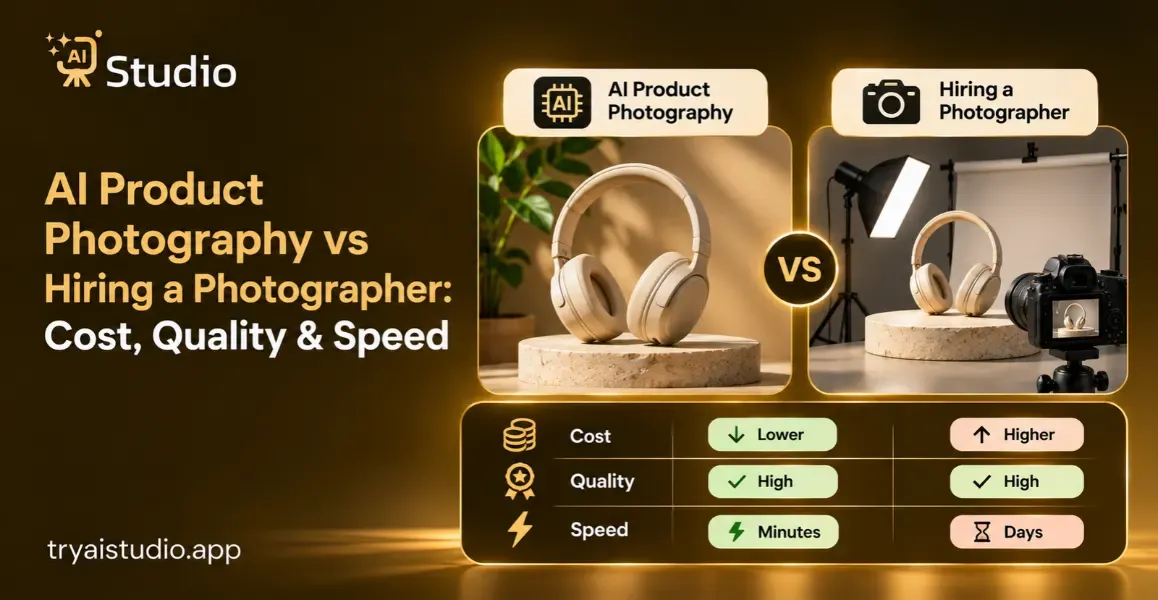
AI product photography is a faster and more affordable option for brands that need high-quality product images regularly. Hiring a professional photographer is a better choice when you need real-life product details, creative direction, and a controlled photoshoot. The right option depends on your budget, product type, and photography needs.
Is AI product photography better than hiring a photographer?
It depends on the job. AI is better when you need many images, fast turnaround, and a low cost per image. A photographer is better when you need total control over a physical set, real texture detail, or a premium campaign look. Neither is "best" for everything.
Can AI replace professional product photographers?
Not fully. AI can replace a large share of everyday catalog, marketplace, and social media work. It cannot replace the person who builds a set, handles a real product in real light, and shapes a brand story on location. Think of AI as a new tool in your kit, not a full replacement for a professional product photographer.
What Is AI Product Photography?
AI-powered product photography tools let you take a flat image of a product and add some polish by creating professional-looking studio shots, lifestyle shots, and on-model images. Simply upload an image, select a theme, and an AI-generated product photography tool will create a scene around your product. There is no need for a studio, lighting, or models.
There are many AI product photography tools available. Some simply cut out the background, while others can produce complete product shoots for fashion, jewellery and accessories using AI. When choosing an AI product photography tool, look at how well it preserves the details of your actual product, including colours, patterns and logos.
What Does a Professional Product Photographer Cost in India?
The traditional product photography pricing will vary depending on your product, how many images you need, what city you're in, and the experience of the photographer. These are just rough guide prices and should be used as a starting point. Always request a quote in writing.
Typical Indian rates
- Brand or product shoot: about ₹1,750 to ₹8,000 per image
- Fashion session: about ₹20,000 to ₹50,000 per session
- Studio rental: about ₹2,000 to ₹7,000 per hour, depending on the city
- Model fees: often ₹12,000 to ₹60,000 or more per day
Big cities such as Mumbai and Delhi can cost 20 to 30 percent more than smaller cities.
The costs people forget
The photographer's fee is not always the final cost. You may also need to pay for a photo retoucher, stylist, props, model travel, and makeup. If the shoot takes longer than planned or you need another round of photos, the total cost can increase further.
You may have to pay extra for seasonal updates. For example, a new look for Diwali or wedding season.
How Much Does AI Product Photography Cost?
Prices can vary depending on what you choose, but generally you will pay a monthly fee or image-based fee. Many international tools will put prices in dollars. You should be sure to check exactly what is included in your package. Many states you can save up to 90% when compared to studio shoots. This will depend on the tool you are using and how much retouching you require.
Is AI product photography cheaper than traditional photography?
Yes, AI product photography is generally more affordable for businesses that need regular catalog images and social media creatives. However, the actual savings depend on the subscription price, image limits, and the amount of editing required.
Say you have 40 kurtis to photograph, and you want 3 images of each. This will give you 120 images. Getting these images taken traditionally will cost you around ₹2,10,000 (excluding models and extra people) if you charge ₹1750 per image.
With our AI plans, you can get these images for a fraction of the price. From as little as ₹600/month at Try AI Studio. This depends on which plan you choose.
You will save money, but you will still have to spend some time reviewing the AI images. So budget a little for this.
AI product photography pricing: what to compare
When you look at AI product photography pricing, compare these points:
- Number of images included each month
- HD download without a watermark
- Commercial use rights
- Categories supported, such as fashion, jewelry, and general products
- Whether you can regenerate until you are happy
Quality: AI vs Traditional Product Photography
Where AI Product Photography Delivers Good Results
AI product photography can produce impressive results for many common eCommerce needs. It works particularly well for:
- Marketplace product images: Clean backgrounds, balanced lighting, and consistent product presentation.
- Lifestyle photography: Creating product scenes without arranging physical props or locations.
- Fashion photography: Generating model-based product images without booking a model for every shoot.
- Seasonal campaigns: Creating different image variations for festivals, special offers, and seasonal promotions.
Another advantage is the number of options AI can generate. You can create multiple versions, compare them, and select the ones that best match your brand.
Where AI Product Photography Can Fall Short
AI-generated images are not always accurate. Some product details may change during image generation, so you need to review every result carefully.
Common issues include:
- Logos and packaging text: Small text, labels, and brand logos may appear distorted or incorrect.
- Product colors: AI may slightly change the original shade, which can create confusion for buyers.
- Jewelry details: Stone settings, chain designs, and metal reflections may not match the actual product.
- Human details: Hands, fabric folds, and body proportions can sometimes look unnatural.
Before publishing an AI-generated image, compare it with the real product. Check the color, logo, print, size, and packaging details. Even a small difference between the image and the delivered product can affect customer trust, reviews, and return rates.
Speed: How Fast Is AI Product Photography Compared to a Photoshoot?
Traditional images are slow. This typically involves finding a photographer, working out a quote, sending examples, booking a date, photographing, waiting for edits, reviewing, and requesting changes. This could take days/weeks.
Creating images with AI is much quicker. Upload your product photo, choose a suitable theme, and adjust the settings to generate a new image. You can review the result and make changes if needed.
Platforms like Try AI Studio will aim to provide you with images that look as though they were taken in a studio in around 10 seconds. More complex products may take a couple of attempts to get right.
This helps when:
- A competitor launches a sale, and you need fresh visuals today
- A festival is two days away
- You want to test three different looks before an ad campaign
- You upload new stock every week
Side-by-Side Comparison
| Factor | Hiring a Photographer | AI Product Photography |
|---|---|---|
| Cost per image | Higher, often thousands of rupees | Lower, usually part of a plan |
| Turnaround | Days to weeks | Seconds to minutes |
| Reshoots and variations | Extra cost and time | Quick to regenerate |
| Real texture and fine detail | Excellent | Needs careful checking |
| Models and sets | Must be booked and paid | Created digitally |
| Scale for big catalogs | Gets expensive fast | Easy to scale |
| Creative direction on set | Strong | Limited to prompts and themes |
| Best for | Hero campaigns, luxury, complex sets | Catalogs, social posts, marketplaces, tests |
AI Product Photography for Ecommerce: Marketplace Rules to Check
If you're selling products on Amazon, Flipkart, Meesho or Myntra, then be sure to check the current requirements for using imagery on these sites, as they can often change.
For example, on Amazon, your main image will have strict guidelines around it, such as needing a plain white background and accurate representation of what you're shipping.
Generally, AI-generated scenes work best as secondary images and A+ Content.
Amazon has also put new guidelines in place around using photorealistic AI-generated people; be sure to check the latest wording on Seller Central.
A safe habit for AI product photography for ecommerce:
- Use accurate, product-true images for your main slot.
- Use AI lifestyle and on-model images in the other slots.
- Check each marketplace's help pages before you publish.
- Keep your original product photos as proof of what you sell.
Should Ecommerce Brands Use AI or Hire a Photographer?
Ecommerce brands should choose between AI product photography and professional photographers based on their budget, product type, and content needs. AI works well for creating product variations quickly and affordably, while photographers are better for premium campaigns and highly detailed product shots. For many brands, combining both offers the best results.
Choose AI when
- You have a small budget or no studio
- You sell many products or update stock often
- You need Instagram, WhatsApp, marketplace, and ad creatives quickly
- You want to test looks before spending on a big shoot
- You want product photography without a photographer for early-stage sales
Hire a photographer when
- You are launching a premium or luxury line
- You need a hero banner, a billboard, or a print campaign
- Your product is hard to show, such as reflective or transparent items
- You want a signature brand look with a real creative team
Use both
Most growing brands do best with a hybrid plan. Pay a photographer for a few hero shots and clean reference photos of your best sellers. Then use AI to build the rest: festive variations, size and color displays, social posts and ad creatives. This keeps quality high and cost under control.
Pros and Cons of AI Product Photography vs Photographers
Both AI product photography and professional photographers have their own advantages and limitations. AI saves time and money while making it easier to create multiple image variations, whereas photographers offer greater control, realistic details, and creative direction. Let's compare their pros and cons to understand which option works best for your business.
AI product photography
Pros
- Much lower cost per image
- Very fast results
- Easy to create many variations
- No studio, model or travel needed
- Simple enough for non-designers
Cons
- Fine details may need checking and re-generating
- Less control than a real set
- Marketplace rules may limit where you use the images
- Quality differs between tools
Hiring a photographer
Pros
- Real product, real light, real texture
- Strong creative direction
- Best for premium brand work
- Useful reference images for future use
Cons
- Higher cost, especially with models and studios
- Slower from booking to delivery
- Reshoots are expensive
- Hard to scale across large catalogs
Conclusion
The choice between AI product photography and hiring a photographer depends on what your business needs. AI makes it easier to create multiple product image variations without arranging a new photoshoot every time. This can help small businesses save time and manage photography costs, especially when they regularly update their product catalogs.
A professional photographer is a better choice when you need real product details, creative control, and high-quality images for special campaigns. For most Indian sellers, using AI for regular product photos and hiring a photographer for a few important shots can be a smart and budget-friendly approach.
Want to see how AI product photography works for your products? Start with one real product image, upload it, choose a theme, and compare the result with your current photos. You can try AI Studio and create your first product image.